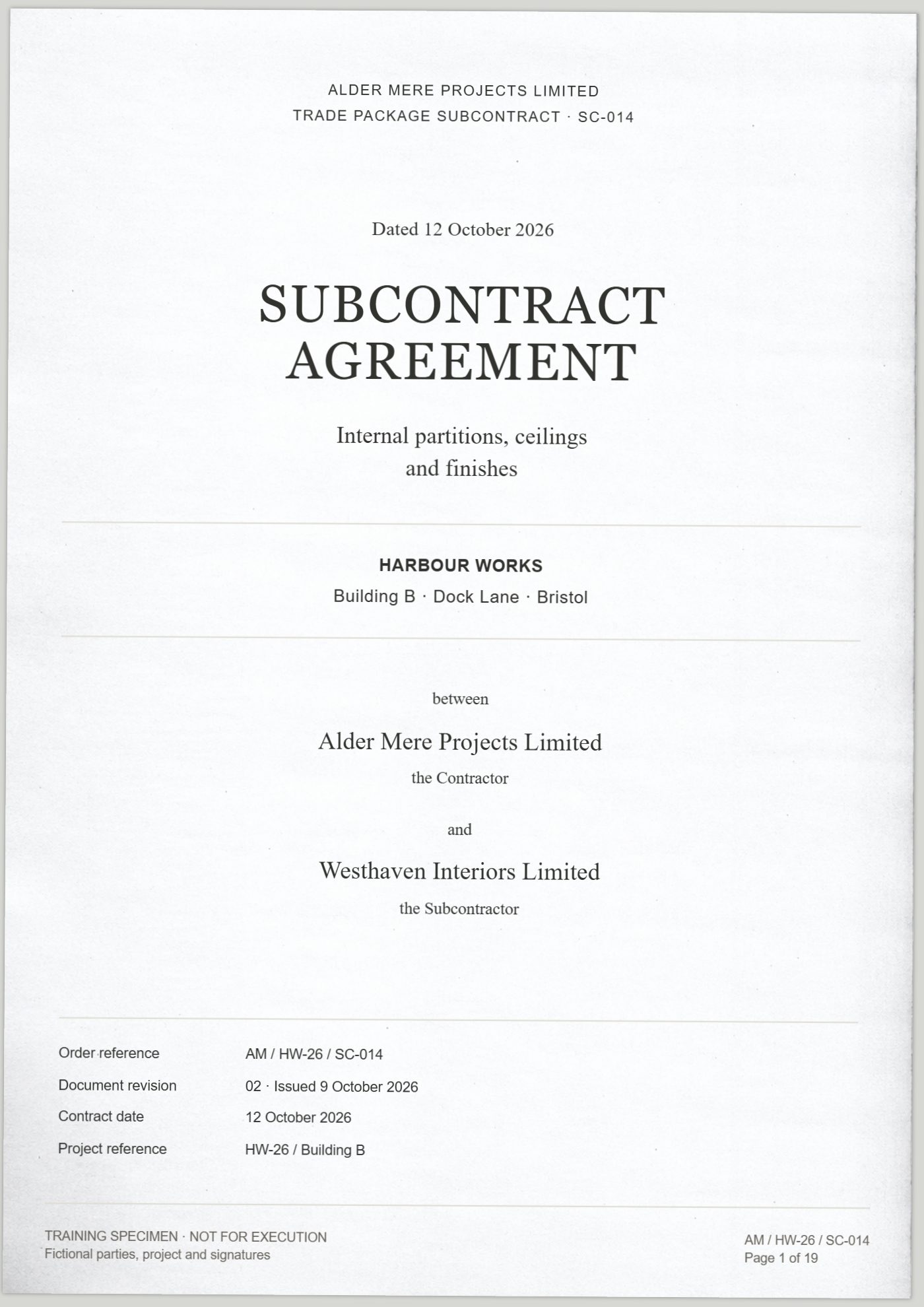
The page viewer needs JavaScript. The complete clause review is available below.
Clause 1.1: Parties and payment entity
The Contractor is Alder Mere Projects Limited, trading as Alder Mere Construction Group. The Subcontractor is Westhaven Interiors Limited. Payments shall be made by such company within the Contractor’s group as the Contractor may nominate, which shall alone be liable for payment. Company registration details are to be confirmed following commencement.
Why it matters: The company engaging you and the company owing the money may be different. A trading name or group label does not identify a dependable legal payer. You finish the work, then learn that payment is owed by another group company with no assets.
Suggested amendment: The Contractor is Alder Mere Projects Limited, company number [verified number], of [registered address]. It remains responsible for all payments under this Subcontract. Appointment of a payment agent shall not release or transfer that responsibility.
Verify both companies, addresses and signing authority. Any guarantee is a separate document to assess.
Clause 1.2: Subcontract sum
The Subcontract Sum is £185,000, inclusive of all obligations under these documents. The Pricing Schedule records £168,500. In the event of any discrepancy, the lower amount shall prevail and VAT shall be deemed included. No adjustment shall arise from an error in the Contractor’s order or the Pricing Schedule.
Why it matters: The sum is inconsistent, and the clause resolves the error against you. The VAT wording can also change the commercial amount you thought you agreed. Your £185,000 quotation becomes a £168,500 obligation, with a further dispute about VAT treatment.
Suggested amendment: The Subcontract Sum is £[agreed sum], exclusive of VAT. VAT shall be accounted for as required by applicable law. The signed Pricing Schedule shall reconcile to that sum. Any discrepancy shall be resolved in writing before execution.
Reconcile the order, priced schedule, discounts, exclusions and applicable VAT or domestic reverse-charge treatment.
Clause 1.3: Contract dates
The Commencement Date is 5 October 2026 and the Completion Date is 4 December 2026. The incorporated programme requires completion on 23 November 2026. The Subcontractor shall meet the earliest date shown in any document, including dates preceding execution of this Subcontract. The Subcontractor is deemed to have allowed for the resulting resources.
Why it matters: There are two finish dates and a retrospective start. You could accept an obligation that your price and resources never allowed for. Delay is measured against November even though you planned to finish in December.
Suggested amendment: The Commencement Date is [agreed date] and the Completion Date is [agreed date], subject to the time-adjustment provisions. The baseline programme is [reference and revision]. Terms for work undertaken before execution are recorded in Schedule [reference].
Align access, information-release dates, sequencing and any sectional completion dates.
Clause 1.4: Tender qualifications
This Subcontract supersedes all prior quotations, clarifications, correspondence and discussions. The Subcontractor’s quotation WI-26091 and pre-order meeting record are incorporated for price reference only; all exclusions, assumptions and qualifications contained in them are withdrawn, whether or not expressly discussed at the pre-order meeting.
Why it matters: Your price may depend on exclusions that this wording removes. A reference to the quotation does not necessarily preserve all of its content. Scaffolding excluded from your tender becomes your responsibility at the same price.
Suggested amendment: The agreed qualifications, assumptions and exclusions in Schedule 2 form part of this Subcontract. On the matters expressly identified there, Schedule 2 prevails over inconsistent requirements elsewhere. No tender qualification is withdrawn except as expressly recorded in that Schedule.
Transfer every accepted qualification into the signed document pack. Check the priority rule in clause 2.2.
Clause 1.5: Early work and letter of intent
Letter of intent LOI-014 dated 2 October 2026 authorised early work up to £15,000 and expired on 9 October 2026. The Subcontractor shall maintain progress pending signature, but work or orders beyond that limit or after expiry are at the Subcontractor’s risk and carry no entitlement to payment unless further authority was first given in writing by the Contractor’s Commercial Director.
Why it matters: A letter of intent may authorise only a limited amount of work for a limited time. Pressure to keep working does not reliably extend either limit. You commit £24,000 against £15,000 of authority while the full subcontract is still being negotiated.
Suggested amendment: The parties shall identify and value all authorised early work and orders in an agreed reconciliation. Those amounts shall be included in payments under this Subcontract, with credit for sums already paid. Any further interim authority shall state its scope, value limit, expiry and applicable terms before further commitments are required.
Read the actual letter, emails and instructions. Reconcile early work when signing the full contract; do not assume signature automatically settles the earlier position.
Clause 2.1: Main contract obligations
The Subcontractor assumes all Contractor obligations under the Main Contract relating directly or indirectly to the Subcontract Works, whether or not the Main Contract or its amendments have been supplied. The Subcontractor acknowledges full knowledge of those documents.
Why it matters: This imports unseen obligations and says you already know them. Broad flow-down wording may extend well beyond your package. An undisclosed main-contract reporting duty or damages provision is later passed to you.
Suggested amendment: Only the Main Contract provisions listed by clause and revision in Schedule 1, and supplied before agreement, are incorporated. They apply only to the stated extent relevant to the Subcontract Works. No general incorporation of other Main Contract obligations is intended.
Obtain the actual terms and amendments. List exclusions and check how imported duties interact with these Conditions.
Clause 2.2: Conflicting requirements
Where the documents are inconsistent, the requirement imposing the greater cost, higher standard or more onerous obligation upon the Subcontractor shall prevail. The Contractor’s interpretation shall be final and shall not constitute a Variation or grounds for additional time.
Why it matters: A discrepancy becomes an automatic increase in your obligation. There is no stable document hierarchy or neutral way to resolve it. Two drawings specify different finishes. You must provide the expensive version without an adjustment.
Suggested amendment: The document priority is: signed Agreement and amendments; agreed qualifications in Schedule 2; these Conditions; scope and specification; drawings; Pricing Schedule. The Subcontractor shall notify discrepancies promptly. A direction changing the agreed scope shall be addressed under clause 4.
A priority list must preserve agreed qualifications. Check drawings, specifications, amendments and the price schedule together.
Clause 2.3: Completeness of scope
The Subcontract Sum includes all work required to complete the package, whether expressly shown or described in the tender documents or not, and all associated work necessary to satisfy the Main Contract requirements. No additional payment shall be due for omissions in the Subcontractor’s pricing or scope allowance.
Why it matters: A broad completion obligation can pull unpriced work into your package. The risk is the open-ended boundary between your scope and other trades, rather than the word “complete” on its own. New coordination requirements are described as an omission from your price rather than a change.
Suggested amendment: The Subcontract Works comprise the work expressly described in the listed documents and reasonably inferable from them at the agreed tender date. They exclude the matters in Schedule 2. Additional requirements outside that scope shall be treated as changes under clause 4.
Agree exclusions, interfaces, design responsibility and attendances. Compare the scope, drawings, pricing notes and clause 10.3.
Clause 2.4: Site information and conditions
The Subcontractor accepts all site conditions, including contamination, asbestos, hidden services and existing defects, including matters which no reasonable inspection could disclose. The Contractor accepts no responsibility for supplied information. All resulting work, delay and disposal costs are included in the Subcontract Sum.
Why it matters: You take the cost of hidden conditions while losing reliance on information supplied to you. Some risks may be impossible to quantify at tender. Opening a ceiling reveals asbestos, but the clause allocates investigation, delay and removal costs to you.
Suggested amendment: The agreed site information and priced assumptions are listed in Schedule 1. On discovering physical conditions not reasonably foreseeable from that information and a reasonable permitted inspection, the Subcontractor shall notify the Contractor. The resulting necessary changes, time and demonstrable additional cost shall be assessed under clauses 3 and 4.
Clarify surveys and responsibility before work. Safety duties still apply regardless of the commercial allocation.
Clause 2.5: Quantities and measurement
Quantities are indicative. The Subcontractor warrants it has checked them and accepts all quantity increases without adjustment, whilst reductions shall reduce the Subcontract Sum at the scheduled rates. No remeasurement claim by the Subcontractor shall be admitted.
Why it matters: The quantity risk is one-sided. A provisional schedule is used as a fixed ceiling on your recovery. A 20% quantity increase is unpaid, while a reduction immediately cuts your price.
Suggested amendment: Items identified as remeasurable in the Pricing Schedule shall be adjusted for actual quantities, upwards or downwards, at the agreed applicable rates. Where the character or conditions materially differ, a fair rate shall be agreed or assessed under clause 4. All other items are priced on the stated lump-sum basis.
Reconcile quantities against drawings and distinguish quantity growth from an instructed scope change.
Clause 2.6: Design standard and performance
The Subcontractor is responsible for all design, including design supplied by others, and shall ensure the completed Subcontract Works are fit for the purposes stated or implied in the Employer’s Requirements, notwithstanding any reasonable skill and care obligation or approval of the design by the Contractor.
Why it matters: A promise that the finished work will achieve a result can be wider than a promise to design competently. “Skill and care” elsewhere may not remove that separate obligation. A design can have been prepared competently yet still fail the promised performance test, creating a claim your insurance may not cover.
Suggested amendment: For design expressly allocated to it in Schedule 1, the Subcontractor shall exercise the reasonable skill and care expected of an appropriately qualified and experienced designer undertaking comparable work. It does not assume responsibility for design by others or give an additional fitness-for-purpose warranty under this clause.
Check the specification and warranties for hidden guarantees. Ask the insurance broker about the actual wording.
Clause 3.1: Access and preceding work
The Contractor gives no assurance of uninterrupted access, possession, completed preceding work or timely design information. The Subcontractor shall bear all resulting delay and disruption without additional time or payment and shall maintain the Completion Date notwithstanding interference by the Contractor or other trades.
Why it matters: Your finish obligation is fixed while the conditions needed to perform can move. Neither time relief nor cost recovery is provided. Rooms are unavailable for two weeks, but your completion date and labour costs remain your problem.
Suggested amendment: The Contractor shall provide access, preceding work and design information in accordance with the agreed programme. To the extent a failure delays or disrupts the Subcontract Works, the Subcontractor is entitled to a reasonable extension and demonstrable additional cost, assessed under the agreed notice and valuation procedures.
Check the damages, notice and valuation clauses. Time relief and cost recovery need separate consideration.
Clause 3.2: Resequencing and acceleration
The Contractor may alter sequence, working hours, areas and milestones and may require acceleration. The Subcontractor shall comply at its own cost, whether or not it is responsible for the need to accelerate. Acceptance of a revised programme constitutes waiver of any related entitlement.
Why it matters: The clause turns programme changes into unpaid acceleration and uses programme acceptance as a waiver. You must add a night shift to recover delay caused elsewhere, with no agreed price.
Suggested amendment: Instructed acceleration or material resequencing shall be subject to an agreed adjustment of price and programme. Agreement of a progress programme shall not itself alter contractual dates or waive entitlements. This clause does not relieve the Subcontractor from responsibility for delay caused by its own breach.
Record resource assumptions and distinguish recovery of your own delay from acceleration requested for another reason.
Clause 3.3: Notice of delay
The Subcontractor shall give written notice of any claim for additional time with complete particulars within seven calendar days after it became, or should have become, aware of the event, as a condition precedent to any entitlement. Continuing effects, incomplete information and the Contractor’s knowledge of the event shall not excuse compliance.
Why it matters: “Condition precedent” makes compliance a gateway to the claim. Calendar days include weekends, and “should have become aware” may start the clock before the cost or delay is clear. The team waits for a reliable delay estimate, but the contractor says the initial notice was already late.
Suggested amendment: The Subcontractor shall give an initial delay notice within [agreed period] after becoming aware of likely delay, with particulars as reasonably available. Late notice shall not automatically extinguish entitlement. The assessment may take account of demonstrable additional loss caused by the lateness, without double recovery.
Separate the initial notice from later particulars. Agree a workable trigger, period, addressee and consequence of delay; keep a notice diary.
Clause 3.4: Concurrent delay
No extension of time shall be due for a Contractor-risk event where it overlaps a delay for which the Subcontractor is responsible, even where the Contractor-risk event would itself have delayed completion and is the dominant cause of delay. The Subcontractor shall bear the cost of recovering the resulting programme delay.
Why it matters: The clause places the risk of overlapping causes on you. That is a commercial allocation to understand and negotiate, not something to assume a court will automatically disregard. A minor late task is used to defeat relief for a separate access failure on the critical work.
Suggested amendment: The effect of each event on completion shall be assessed from the programme and contemporary records. Mere overlap in dates is not sufficient to establish concurrency. Genuine concurrent Contractor-risk and Subcontractor-risk delay shall be assessed under the expressly agreed time and cost rules in Schedule [reference].
Define genuine concurrent delay and assess cause and effect. Review time relief separately from money and the duty to accelerate.
Clause 3.5: Delay damages
For failure to complete by the applicable date, the Subcontractor shall pay £3,500 for each week or part thereof, without an aggregate limit and without prejudice to recovery of Main Contract delay charges and other losses for the same period. These amounts may be deducted subject to the payment provisions.
Why it matters: A stated weekly rate can look like a limit when other wording adds further heads of loss. Read the rate, overall cap, time-extension rights and other recovery clauses together. You allow for the weekly rate, then face an additional claim for the main contractor’s delay losses.
Suggested amendment: Delay damages of £[agreed rate] per week, calculated pro rata, apply only to culpable delay beyond the Completion Date as extended. Aggregate delay damages shall not exceed £[agreed cap]. They are the agreed remedy for that delay, without duplicate recovery of the same loss under another provision.
Ask whether the rate is the agreed remedy for the same delay and prevent double recovery. A delay-damages clause is not automatically invalid merely because it is expensive.
Clause 4.1: Authority to instruct
The Subcontractor shall comply immediately with all oral or written directions of any site representative. No direction shall entitle it to additional payment unless confirmed in advance in writing by the Contractor’s Commercial Director. The site manager’s signature on a record confirms attendance only and shall never authorise payment.
Why it matters: You must follow site directions, but the payment clause recognises only a different person’s written authorisation. Site instructions and signed daywork sheets may prove work happened without agreeing entitlement or price. The site manager orders a change, but the Commercial Director never gives the written approval required for payment.
Suggested amendment: Only representatives listed in the agreed authority schedule may instruct changes. The Subcontractor shall confirm an urgent oral instruction in writing promptly. An instruction from an authorised representative engages the change procedure. The parties shall maintain a shared instruction record.
Name authorised people and agree how urgent directions are confirmed. A signature recording hours is not necessarily approval of a variation.
Clause 4.2: Change quotation deadline
A fully priced quotation and all supporting evidence must be submitted within seven calendar days of the instruction, failing which entitlement to any adjustment is waived. Lack of design detail or third-party quotations shall not extend that period.
Why it matters: The clause asks for a complete assessment before the full effect may be knowable, then treats missing that deadline as loss of the claim. A supplier takes a week to quote, and your whole additional payment is challenged.
Suggested amendment: The Subcontractor shall provide an initial indication of cost and time within [agreed period] after receiving sufficient information, followed by reasonable particulars. Failure to agree a quotation before execution does not make instructed work free of charge. Undisputed and reasonably assessed amounts shall be included in interim valuations.
Provide an early notice and provisional estimate, then update it. Negotiate a realistic period for substantiation and a route for instructed work whose final value remains disputed.
Clause 4.3: Basis of valuation
The Contractor shall value changes at the lowest rate in any of the Subcontractor’s tenders for any project. Such rates are conclusive and exclude supervision, overheads, profit, disruption and effects on unchanged work, notwithstanding different quantities, location, sequence or working conditions.
Why it matters: A rate from another job may not reflect this work. The exclusions remove genuine components of the cost of a change. Out-of-hours work in small areas is paid at a bulk daytime rate from another project.
Suggested amendment: Changes shall be valued using subcontract rates where the work and conditions are comparable. Otherwise a fair valuation shall reflect reasonable costs and the agreed allowance for overheads and profit. Demonstrable consequential effects on unchanged work shall be assessed separately, without double recovery.
Separate direct change costs from delay or disruption claims, and keep records for both.
Clause 4.4: Omissions and replacement work
The Contractor may omit any work and give it to others. The Subcontractor shall receive no payment for committed materials, cancellation charges or demobilisation arising from the omission. The omitted value shall be deducted immediately at the Contractor’s valuation.
Why it matters: An unrestricted omission power leaves you carrying costs already reasonably committed to deliver the agreed scope. A package is removed after you order bespoke materials that cannot be returned.
Suggested amendment: The Contractor may omit work only within the expressly agreed omission power. Any transfer of omitted work to others requires the Subcontractor’s agreement. The valuation shall account for unavoidable reasonable commitments, cancellation and demobilisation costs, subject to evidence and mitigation. Any treatment of lost profit shall be expressly agreed.
The treatment of lost profit is a separate negotiation. Do not assume the same entitlement for every omission.
Clause 4.5: Fixed price and duration
The Subcontract Sum and rates shall remain fixed for the actual duration of the works, including any extension, with no adjustment for inflation, increased wages, materials or changes in law. No separate adjustment shall be made for these matters under the variation provisions.
Why it matters: A fixed price can be a deliberate commercial choice. The trap is an unlimited duration or wider risk than you priced, especially if the contractor causes the extension. A delayed project runs into a further year while you absorb all additional costs.
Suggested amendment: The price is based on the scope, duration and assumptions in the agreed schedules. It remains subject to adjustments expressly permitted for changes, Contractor-risk delay and the changes in law identified in Schedule [reference]. Inflation risk is allocated only as stated in that Schedule.
State the price base, duration and assumptions. Separate inflation from instructed changes and contractor-caused delay; they need not share the same treatment.
Clause 5.1: Payment due date
A valuation shall become due for payment only when the Contractor elects to approve it, there being no obligation to approve within any particular period. The Contractor may request further documents or defer consideration until the following valuation cycle.
Why it matters: For a construction contract covered by the Act, the payment mechanism must establish what becomes due and when. Open-ended discretion is a compliance concern. Your application sits unapproved while payroll and supplier bills continue.
Suggested amendment: Interim valuations shall be made on the last working day of each month, beginning in the month of commencement and continuing while sums remain to be assessed. The due date is seven calendar days after that valuation date. Valuations shall include properly executed work and other amounts payable under the agreed valuation rules, less previous payments.
The Scheme may supply missing or non-compliant provisions. Verify which provisions apply to the actual contract.
Clause 5.2: Final date and invoice approval
The final date for payment is sixty days after acceptance of a valid invoice, with the period restarting whenever further information is requested. The Contractor is the sole judge of invoice validity and may amend its requirements without notice.
Why it matters: The headline number does not tell you when money arrives if invoice acceptance is open-ended. The final date also needs to fit the applicable Construction Act payment mechanism. A query near the end of the period restarts the clock, leaving you funding another payment cycle.
Suggested amendment: The final date for payment is twenty-one calendar days after the due date. Administrative invoice requirements shall not alter that date or restart the payment period. The payment timetable shall continue after the original completion date until the account is finally determined.
Write out valuation, due date, notices and final date on one timeline. Do not treat a headline payment period as proof of compliance; check any applicable statutory or procurement requirements.
Clause 5.3: Receipt of upstream payment
Notwithstanding any other provision, no payment shall be due unless and until the Contractor has received the corresponding payment from the Employer, whatever the reason for non-payment. The Subcontractor accepts the entire risk of the Employer’s default or refusal to pay.
Why it matters: Section 113 generally makes pay-when-paid conditions ineffective for covered contracts. There is a limited upstream-insolvency exception; this clause goes much further. An employer dispute unrelated to your performance is used to stop your payment.
Suggested amendment: The Contractor’s payment obligations under this Subcontract are independent of receipt of payment from the Employer or any other person. Non-payment upstream shall not postpone a subcontract due date or final date for payment.
Do not treat every mention of insolvency as valid. The drafting and statutory definition matter.
Clause 5.4: Upstream certification
The Subcontractor’s entitlement shall also depend on certification that the Contractor has fully performed its obligations under the Main Contract. No sum shall be payable while the Employer or its certifier disputes any aspect of the Main Contract works.
Why it matters: The Act restricts payment mechanisms dependent on performance or certification under another contract. This condition ties your money to the entire main contract. Your completed package is unpaid because another trade’s work has not been certified.
Suggested amendment: The assessment and timing of payment under this Subcontract shall not depend on certification of performance under the Main Contract. The Subcontract Works shall be valued through the subcontract payment mechanism independently of any dispute concerning other Project works.
Read this together with clauses 5.1 and 5.3. Removing only one upstream condition leaves the others in place.
Clause 5.5: Applications and supporting documents
Applications must be uploaded using the current portal form by noon on the dates in Schedule 4, with signed allocation sheets, photographs and all information requested by the Contractor. Any omission or later request for information renders the entire application invalid and moves it to the next valuation cycle. Email submission shall not constitute an application.
Why it matters: Timing, method, amount and basis can matter to a valid application. This wording also lets later information requests invalidate the whole submission, making the requirements a moving target. A missing attachment is used to push a month’s work into the next cycle, even though its value and basis are clear.
Suggested amendment: Applications shall identify the sum claimed and its basis and be submitted by the agreed method and dates in Schedule 4. Missing supplementary information shall be identified promptly and shall not by itself postpone the payment timetable. The agreed payment-notice, default-notice and pay-less provisions and applicable statutory rights remain effective.
Keep submission evidence and a fallback if the portal fails. A rejected application does not automatically remove statutory duties, but whether your submission is an effective notice depends on the wording and facts.
Clause 5.6: End of the interim payment schedule
The only interim valuation dates are those listed in Schedule 4. No further interim valuations shall take place after 31 December 2026, whether or not the Subcontract Works remain incomplete. Any remaining balance shall be dealt with through the final-account provisions in clause 8.
Why it matters: A list of dates can run out if the work overruns. Do not assume monthly payments continue automatically or that the statutory Scheme will necessarily fill the gap in the way you expect. The programme slips into January but the contractor says there is no next interim valuation date.
Suggested amendment: Interim valuations shall continue monthly after the last listed date while the Subcontract Works remain incomplete, and thereafter as required by the agreed final-payment mechanism. The due-date, notice and final-date provisions shall apply to those continuing valuations on the same basis.
Extend the timetable whenever the programme changes and agree a continuation rule now. Read it with the payment mechanism as a whole.
Clause 6.1: Group and cross-contract set-off
The Contractor may deduct any amount alleged to be owed to it or any associated company under this or any other contract, whether disputed, contingent, unquantified or not yet due. It need not establish the allegation before making the deduction.
Why it matters: Cash from a successful project can fund an unrelated disputed claim, including one involving another group company. An unproven charge on an old job is removed from this month’s valuation.
Suggested amendment: Set-off under this Subcontract is limited to substantiated sums arising under this Subcontract. No deduction is permitted solely for an alleged debt to an associated company or under another contract. Every deduction remains subject to the applicable payment-notice requirements and any statutory restrictions.
Cross-contract set-off is not automatically prohibited. Examine the wording and the payment regime before deciding what can be deducted.
Clause 6.2: Notice of deductions
All deductions, abatements and contra-charges may be made at any time, without a pay-less notice and without identifying the calculation or grounds. They may be introduced after the final date for payment or applied retrospectively to an earlier valuation.
Why it matters: Where the statutory notified-sum regime applies, paying less generally requires a valid notice served in time, subject to statutory exceptions. The bank receipt is short and the explanation arrives only after payment was due.
Suggested amendment: A pay-less notice shall state the sum considered due at its date and the basis of calculation, and shall be served at least seven calendar days before the final date for payment. All reductions from the notified sum remain subject to applicable statutory provisions and exceptions.
A valuation dispute and an immediate obligation to pay the notified sum are different questions.
Clause 6.3: Retention
Retention shall be five per cent of each payment, with no reduction at completion of the Subcontract Works. No part shall be released until all defects on the entire Project have been resolved and the Employer has paid every sum owed to the Contractor. Release may be deferred without an ultimate date.
Why it matters: The percentage is only part of the bargain. Release is tied to the whole project and upstream payment, rather than completion and defects in your own package. Your work is complete, but another package’s defect keeps your retention outstanding for years.
Suggested amendment: Any retention permitted by applicable law shall be at the agreed percentage and subject to an agreed monetary cap stated in the Particulars. Half shall be included in the first payment following practical completion of the Subcontract Works, and the balance in the first payment following the agreed rectification period, subject only to a properly notified deduction for outstanding defects in those works. Release shall not depend on completion of other work or payment under the Main Contract.
Check release triggers, dates and any cap, and the law applicable to the agreement. Announced retention reforms are not the same as commenced provisions.
Clause 6.4: Damage and contra-charges
The Subcontractor shall bear all damage and site-cleaning costs in its working areas, regardless of who caused them and without an opportunity to inspect or remedy. The Contractor’s estimate plus thirty per cent administration shall be conclusive evidence of the sum payable.
Why it matters: You take responsibility for others’ actions, and the payer determines its own charge without evidence or a remedy process. Damage caused after your team leaves is charged to your account with a substantial mark-up.
Suggested amendment: A contra-charge must identify the breach attributable to the Subcontractor and the reasonable resulting cost, with supporting evidence. Except in an emergency, the Contractor shall give a reasonable opportunity to inspect and remedy. Charges shall exclude betterment and be subject to the agreed payment-notice process.
Keep dated handover photographs and records of who had access. Agree the treatment of any administration charge.
Clause 6.5: Performance bond
Before payment the Subcontractor shall provide a bond for ten per cent of the Subcontract Sum, payable on the Contractor’s first written demand without proof of default and without an expiry date. Failure to maintain the bond permits withholding of all sums otherwise payable.
Why it matters: An on-demand bond may be called before the underlying dispute is resolved. An indefinite obligation and blanket withholding right increase the exposure. The bond is called while you dispute the allegation, creating immediate funding pressure.
Suggested amendment: Any required performance bond shall be in the form attached to Schedule [reference], for £[agreed amount], and conditional on the default and recovery requirements stated in that form. Its reduction and expiry dates are [agreed terms]. No other bond form is incorporated by reference.
A bond is not inherently unacceptable. Review its call conditions, amount, reduction and expiry, and the combined cost of retention, guarantees and the bond.
Clause 6.6: Personal guarantee
Each director signing on behalf of the Subcontractor also signs in a personal capacity and guarantees without limit all present and future liabilities of the Subcontractor to every Contractor group company. The guarantee survives all variations, settlements and changes in the parties.
Why it matters: A signature intended for the company creates a separate personal obligation, extending beyond this subcontract and beyond the present group relationship. A director’s personal assets become exposed to company liabilities from other jobs.
Suggested amendment: A person signing this Subcontract for a company signs solely in an authorised representative capacity and gives no personal guarantee by that signature. Any separately proposed guarantee requires an express, separately executed agreement identifying its scope, limit and duration.
This is particularly important for owner-managed firms. Company signing and personal signing are different; do not assume the company’s limited liability protects a separate guarantor.
Clause 7.1: General indemnity
The Subcontractor shall indemnify the Contractor against all losses, liabilities, costs and expenses arising out of any breach of this Subcontract, including all claims made under the Main Contract and all legal costs, without an express limit or exclusion for the Contractor’s own contribution. This indemnity is additional to the Contractor’s other remedies.
Why it matters: A blanket indemnity can widen the losses, costs or routes of recovery beyond what you expected. It needs to be read with causation, responsibility, insurance and the liability cap. A package dispute brings a wider demand for upstream losses and legal costs under the indemnity.
Suggested amendment: Any indemnity applies only to the identified risks expressly set out in Schedule [reference] and to losses caused by the Subcontractor’s allocated responsibility. It excludes loss to the extent caused by the indemnified party’s breach or negligence and is subject to the agreed liability provisions.
An indemnity is not automatically invalid. Identify the particular risk it should cover and define its boundaries instead of accepting an all-purpose promise.
Clause 7.2: Unrestricted liability
The Subcontractor’s liability is unlimited and includes loss of profit, revenue, use, opportunity and all third-party liabilities. Any cap elsewhere shall not apply to breach, negligence, indemnities, delay, defects or design, or to any liability claimed by an associated company.
Why it matters: The exclusions would remove most ordinary claims from any apparent cap. A headline limit is of little use if the operative clauses bypass it. You believe liability is capped at the order value, but the actual claim falls within an exception.
Suggested amendment: Subject to liabilities which cannot lawfully be limited and the expressly identified exceptions in Schedule [reference], the Subcontractor’s aggregate liability arising under or in connection with this Subcontract shall not exceed £[agreed cap]. Treatment of particular losses and any sub-limits is set out exhaustively in that Schedule.
Set the amount with regard to scope, exposure and insurance. Check damages, indemnities, warranties and security against it.
Clause 7.3: Insurance availability
The Subcontractor shall maintain professional indemnity insurance of £5 million for each claim for twelve years after completion, irrespective of market availability, premium or exclusions. Evidence of renewal and the policy terms shall be supplied annually on request.
Why it matters: Required cover, duration and basis may be unavailable or incompatible with your policy. Insurance requirements do not automatically cap contractual liability. The market withdraws cover, leaving you in continuing breach despite reasonable efforts to insure.
Suggested amendment: The Subcontractor shall maintain professional indemnity insurance at the agreed level for the agreed period, provided that cover remains available on commercially reasonable terms. If that position changes, it shall notify the Contractor promptly and the parties shall agree reasonable alternative measures. The liability provisions and the insurance requirement shall be reviewed together.
This matters where your package includes design. Check each-claim versus aggregate cover, exclusions, excess, duration and market availability with the broker; the contract limit and insured amount are not the same thing.
Clause 7.4: Collateral warranties
Within five days of request the Subcontractor shall execute warranties for the Employer, funders, purchasers and tenants in any form required by the Contractor, whether or not supplied with this Agreement and without entitlement to additional payment. The Contractor may withhold payment until every requested warranty is delivered.
Why it matters: Agreeing to sign a document later can import duties you have never priced or insured. The unseen form may omit the limits and defences negotiated in the subcontract. A late warranty request adds an absolute design guarantee and removes the agreed cap.
Suggested amendment: Only the warranties and beneficiaries identified in Schedule [reference] are required. Each warranty shall be in the attached agreed form, impose no greater liability than this Subcontract and preserve equivalent limitations and defences. The documents shall prevent double recovery of the same loss.
This is relevant where warranties are required. Obtain the actual forms and identify beneficiaries, assignment rights, liability periods and equivalent defences before agreeing them.
Clause 7.5: Materials, ownership and risk
Ownership of all materials intended for the Subcontract Works shall pass to the Contractor on their identification to the Project, whether paid for or not, whilst all risk of loss and damage remains with the Subcontractor until completion of the entire Project. Off-site materials shall not be included in an interim valuation.
Why it matters: Ownership, payment and responsibility for damage are separate questions. This clause transfers the materials early while leaving their funding and care with you. You buy and identify materials for the job, receive no payment for them off site, then face replacement costs if they are damaged.
Suggested amendment: The parties shall agree when identified materials are payable and when title and risk pass. Any off-site payment arrangement shall identify the goods, storage, insurance, inspection rights and evidence of good title. No transfer shall be required in breach of a supplier’s retained ownership rights; all arrangements shall be reconciled before commitment.
Check supplier retention-of-title terms, vesting documents, storage and insurance. A certificate cannot transfer ownership you do not hold.
Clause 8.1: Practical completion
Practical completion occurs only when the Contractor is entirely satisfied with all Project works, including other contractors’ work, and every minor defect and administrative omission has been eliminated. Occupation or use of the Subcontract Works shall not require certification.
Why it matters: Completion of your package is tied to unrelated works and unrestricted satisfaction. This can prolong damages, insurance and retention exposure. Your area is in use, but a minor outstanding record or another trade prevents recognition of completion.
Suggested amendment: Practical completion shall be assessed against the objective requirements for the Subcontract Works in Schedule [reference]. Minor outstanding items that do not prevent the agreed use shall be listed with reasonable correction dates. Unrelated work by others shall not of itself prevent certification of the Subcontract Works.
Align completion with damages cessation, risk transfer, defects periods and any retention release.
Clause 8.2: Defects period
The defects rectification period is twenty-four months from completion of the entire Project. Any repair shall restart that period for the whole of the Subcontract Works, without any final long-stop date. The Contractor may direct betterment and replacement of undamaged adjoining work at the Subcontractor’s cost.
Why it matters: A repair repeatedly extends the whole package obligation and can require improvements beyond correcting your defect. A small repair near the end of the two-year period starts another two years for all your work.
Suggested amendment: The rectification period is [agreed period] from practical completion of the Subcontract Works. Any renewed rectification period applies only to the repaired element and ends no later than [agreed long-stop]. Correction shall restore contractual compliance and shall not include unagreed betterment. Other legal rights remain subject to their applicable limits.
Separate the period for returning to fix defects from wider liability for breach. Agree what starts the period, what a repair resets and a final end date for the contractual rectification process.
Clause 8.3: Final account deadline
The final account, with all claims and substantiation, must be received within twenty-eight days after the Contractor first considers the work complete, failing which all unclaimed sums are waived. The Contractor need not notify that date or permit revision of the submission.
Why it matters: The risk combines an uncertain start date, a short submission period and loss of omitted claims. You may not know that the clock is running while variations are still being discussed. A disputed change is omitted from a hurried account and treated as abandoned.
Suggested amendment: The Subcontractor shall submit its final account within [agreed period] after written notification of practical completion. The submission shall identify outstanding matters and the information needed to resolve them. The Contractor shall assess it within [agreed period], giving reasons and allowing the defined review and dispute process.
Record reservations precisely and check how the final certificate and settlement language interact with them.
Clause 8.4: Conclusive final certificate
The Contractor’s final certificate shall conclusively determine all entitlements unless challenged within fourteen calendar days of issue by commencing adjudication or court proceedings. Mistake, missing information and unresolved correspondence shall not permit correction after that period.
Why it matters: A finality clause can make a valuation binding if you miss its challenge procedure. Fourteen days may be too short to obtain records and advice, particularly if issue and receipt differ. A certificate arrives during leave and is later relied on as final despite an obvious valuation error.
Suggested amendment: The final certificate shall identify the amount assessed and its basis. Either party may challenge it under the expressly agreed dispute procedure within [agreed period] after proper service. A timely challenge prevents conclusiveness on the matters challenged. Applicable statutory rights and agreed error-correction provisions are preserved.
Read the exact challenge trigger, permitted action and effect of a timely challenge. A finality clause is not automatically ineffective; statutory rights and contractual conclusivity require careful review.
Clause 8.5: Release before payment
Payment of any final-account sum is conditional upon signature of a full release of all claims, known or unknown, whether included in that payment or not. Banking a payment or acknowledging its receipt shall itself constitute such a release.
Why it matters: Payment of an amount already due is used to obtain a much wider settlement, including claims the payment does not address. You receive an undisputed balance and discover it is said to settle a separate outstanding change.
Suggested amendment: Payment, banking a payment or acknowledging receipt of an undisputed sum does not itself release other entitlements. Any settlement shall be separately recorded and shall identify the claims settled, the consideration and any matters expressly reserved by the parties.
Read remittance wording, settlement emails and releases alongside the subcontract before accepting a final settlement.
Clause 9.1: Suspension for non-payment
The Subcontractor shall continue all obligations notwithstanding non-payment and irrevocably waives every statutory or contractual right to suspend performance. Any suspension is a repudiatory breach permitting immediate termination and recovery of all resulting losses.
Why it matters: Section 112 provides a qualified suspension right for covered contracts, including notice requirements. This blanket waiver should not be relied on as overriding it. You are told to keep funding the work despite a qualifying failure to pay.
Suggested amendment: Nothing in this Subcontract excludes the right to suspend under section 112 of the Housing Grants, Construction and Regeneration Act 1996 where it applies. The statutory grounds, notice requirements and consequences apply. Additional contractual suspension rights, if any, are stated expressly in Schedule [reference].
Suspension is a consequential step. Verify that the payment, grounds and notice requirements are satisfied before acting.
Clause 9.2: Contractor suspension
The Contractor may suspend any part of the work indefinitely for convenience. The Subcontractor shall retain its resources available, bear all demobilisation and remobilisation cost and have no right to terminate, however long the suspension continues.
Why it matters: The contractor can stop the work while tying up your resources without a cost mechanism or exit point. An eight-week job pauses for six months, but you are still expected to reserve the team.
Suggested amendment: A Contractor-directed suspension not caused by the Subcontractor’s breach shall entitle the Subcontractor to reasonable time and cost adjustments, including necessary demobilisation, protection and remobilisation. After [agreed prolonged period], the Subcontractor may terminate on [agreed notice], with valuation under the agreed termination provisions.
Include materials, storage, plant, staffing and supplier commitments in the consequences.
Clause 9.3: Termination for convenience
The Contractor may terminate for convenience on seven days’ notice. The termination valuation shall include properly executed work only and shall exclude committed materials not yet incorporated, cancellation charges and demobilisation costs. No compensation shall be payable for loss of profit on omitted work.
Why it matters: The practical exposure is the cost already committed when the contractor exercises its right to end the job. A right to terminate for convenience is not automatically invalid; its financial consequences need pricing and agreement. A specialist order cannot be cancelled and your team must leave site, but the settlement covers only installed work.
Suggested amendment: On termination for convenience, the Subcontractor shall be paid for properly executed work, reasonably committed project materials and unavoidable reasonable cancellation, demobilisation and close-out costs, less sums already paid. The parties shall agree expressly the treatment of profit on unperformed work. Accrued rights are preserved.
Check notice, valuation, payment dates and supplier cancellation terms together. Distinguish unavoidable exit costs from a separate negotiation about future profit.
Clause 9.4: Default and step-in
Any breach, however minor, permits immediate termination without warning. The Contractor may then seize the Subcontractor’s plant, tools and hired equipment and charge all completion costs without mitigation. No equivalent remedy is available for the Contractor’s breach.
Why it matters: There is no proportionate default process, and the power purports to reach property that may belong to others. Completion costs are uncontrolled. A minor administrative breach leads to termination and an attempt to keep hired equipment on site.
Suggested amendment: Termination for remediable material default requires written particulars and a reasonable stated opportunity to remedy, except in defined urgent circumstances. Any step-in right is limited to rights lawfully available to the Contractor. Completion costs must be reasonable, evidenced and mitigated. Neither party acquires ownership of third-party equipment by this clause.
Check reciprocal remedies, plant ownership, hire terms and the effect of termination on records and access.
Clause 9.5: Restriction on adjudication
No dispute may be referred to adjudication until the whole Project is complete and ninety days of mandatory negotiations have expired. Any earlier referral shall be void and constitute a breach by the referring party.
Why it matters: For covered contracts, the statutory right is to refer a dispute to adjudication at any time. Completion and negotiation hurdles cannot simply postpone it. A current payment dispute is parked until a project finish date outside your control.
Suggested amendment: Either party may refer a dispute to adjudication at any time in accordance with the applicable statutory provisions. Negotiation or mediation does not prevent that referral. The parties shall comply with the adjudicator’s decision unless and until revised through the applicable final dispute process.
Confirm that a dispute has arisen, the contract is within scope and the referral process is correct.
Clause 9.6: Costs of adjudication
The Subcontractor shall pay all of the Contractor’s legal and expert costs of every adjudication, regardless of who refers the dispute or who succeeds, together with every fee of the adjudicator. This liability arises automatically on service of a notice of adjudication.
Why it matters: Section 108A restricts pre-dispute allocation of adjudication costs. Party costs and the adjudicator’s fees need distinct treatment under its permitted arrangements. The threatened cost of a successful payment claim is used to deter you from bringing it.
Suggested amendment: Neither party is automatically liable for the other party’s legal or expert costs of adjudication under this Subcontract. Allocation of adjudication costs, including the adjudicator’s fees and expenses, shall comply with section 108A of the Housing Grants, Construction and Regeneration Act 1996 and the applicable adjudication procedure.
Obtain advice on the precise costs wording; the rules for adjudicator fees are not identical to the rules for party costs.
Clause 10.1: Service of notices
Subcontractor notices must be delivered in duplicate original by registered post to the commercial director at an address to be notified later and are valid only when that director personally acknowledges receipt. Contractor notices are effective immediately when uploaded to any supplier portal.
Why it matters: The address is missing, service depends on the recipient’s cooperation, and the two parties have different rules. This compounds every short deadline. A timely notice is said to be invalid because a director never acknowledged it.
Suggested amendment: Notices shall be served by the permitted methods at the named postal and email addresses in Schedule [reference], using the objective receipt rules stated there. Actual personal acknowledgement is not a condition of service. Working days exclude Saturdays, Sundays and public holidays in England. Statutory notice requirements are preserved.
Test the notice process against clauses 3.3, 4.2, 5.5 and 8.4 before signing.
Clause 10.2: Transfer of obligations
The Contractor may transfer all rights and obligations to any person without consent, whereupon the original Contractor is released from all liabilities, including unpaid sums. The Subcontractor may not assign a receivable or subcontract any work without consent which may be withheld absolutely.
Why it matters: The drafting attempts to release the company you assessed and replace it with an unknown debtor. Assignment of rights and transfer of obligations are different issues. The job moves to a thinly funded entity after you have already incurred the costs.
Suggested amendment: A transfer that releases the Contractor from obligations requires the Subcontractor’s express written agreement. Accrued liabilities remain with the Contractor unless expressly settled. Permitted assignments of rights and related consent requirements are stated separately in Schedule [reference].
Check the proposed transferee, guarantees and any novation document rather than relying on the word ‘assignment’.
Clause 10.3: Site facilities and attendances
The Subcontractor shall allow for all unloading, lifting, access equipment, storage, temporary supplies and waste removal required for its work. Any facility provided by the Contractor is discretionary and may be withdrawn or charged at rates notified from time to time, without adjustment to the Subcontract Sum or Completion Date.
Why it matters: A price can assume shared facilities that the contract never promises. A broad allowance then makes you pay again when the facility is unavailable or a charge appears. You priced free unloading and waste facilities but later receive charges for both, or must hire alternatives at short notice.
Suggested amendment: An agreed attendance schedule shall identify each facility, its provider, availability period and any included charge. Withdrawal or restriction of a Contractor-provided facility, other than due to the Subcontractor’s breach, shall be dealt with under the agreed time and valuation procedures. Additional charges require prior agreement.
Check the tender assumptions and actual site arrangements: lifting, scaffold alterations, power, water, access, storage, welfare and waste. Statutory safety responsibilities still apply.
Clause 10.4: Document register and incorporation
Schedule 1 consists of the Main Contract [not attached], Employer’s Requirements [revision not stated], drawing series A-100 [latest version] and programme P03. The Subcontractor confirms that all missing schedules and future revisions have been received, checked and accepted without qualification. Schedule 2 qualifications: none. Bond and warranty forms: to follow.
Why it matters: The register does not identify a fixed document set and includes an untrue receipt statement. The empty qualifications schedule contradicts your negotiated exclusions. A later drawing or security form is treated as something you accepted at the original price.
Suggested amendment: The incorporated documents are only those individually identified by title, date and revision in the completed, signed document register. Agreed qualifications and security forms are attached. Later revisions do not alter the agreed scope, price, time or risk allocation except through the applicable agreed change procedure.
Compare the final pack with the negotiation record, including price, programme, schedules and cross-references.
Clause 10.5: Acceptance and signing capacity
Attendance, ordering materials or commencing any work constitutes unconditional acceptance of these terms, including all provisions not yet supplied. The signatory confirms that it signs both for the Subcontractor and personally as guarantor under clause 6.6, notwithstanding any outstanding comments or negotiations.
Why it matters: Conduct can create binding obligations before a formal signature. This clause also adds a personal guarantee to a company signature and disregards unresolved negotiations. Mobilising is treated as acceptance of disputed terms, and a director signs an unintended personal obligation.
Suggested amendment: The parties shall record their agreement and authorised company signing capacities before mobilisation. Any authorised early work shall be governed by a separate written interim arrangement identifying scope, value limit, duration and applicable terms. A signature for the Subcontractor does not create a personal guarantee. Unresolved qualifications are not treated as withdrawn by this clause.
No signature does not automatically mean no contract. Check the actual communications and conduct with appropriate advice.